Monday, January 11, 2010

Fluid Mechanics / Dynamics : Lecture Notes, Applets..

I came across this 350+ page lecture notes "Fluid Mechanics for Civil Engineers" by Bruce Hunt of Univ of Canterbury and straightaway, having read a few chapters, included it in my important online book list.

http://www.civil.canterbury.ac.nz/pubs/FM4CE.pdf

The chapters listed in the book include
1. Fundamental eqns of fluid motion (such as Fundamentals of Fluid Mechanics)
2. Fluid Statics
3. Control Volume Methods (There you go..nice fundamental description)
4. Differential eqn methods
5. Irrotational Flow
6. Laminar / Turb flow
7. Boundary layer aspects
8. Drag / Lift theories and discussions
9. Dimensional analysis and model similitude (now im gathering my undergrad works...wow)
10. Steady pipe / open channel flows
11. unsteady pipe and open channel flows

I kinda liked the overall description provided in the notes..its pretty easy to understand and numerics are well organized.

Another nice lecture notes I found in the web:

http://www.icaen.uiowa.edu/~fluids/

This is the Univ Iowa's Dr. Stern's course on mechanics of fluids and transport processes. Contains some nice
chapters and discussions.

Applets / Calculators

This is an yet another fluid applet that I recently came across. An Rotating U-tube Applet !!
Check it out here

http://www.ce.utexas.edu/prof/kinnas/319LAB/Applets/RotatingTubes/RotatingTubes.html

Another Water-Mercury Manometer applet developed by UT Austin guys

http://www.ce.utexas.edu/prof/kinnas/319LAB/Applets/Manometer1.html

Some more sweet applets !!

Looking at the impulse-momentum principle using Applets (from UT austin again)

http://www.ce.utexas.edu/prof/kinnas/319LAB/Applets/Momentum/Momentum.html

Hydrofoil flow Applet: http://www.ce.utexas.edu/prof/kinnas/319LAB/Applets/Hydrofoil/

I just listed a few applets that I was viewing...Find more applets and cool fluid stuff from Prof. Kinnas lab here.

http://www.ce.utexas.edu/prof/kinnas/319LAB/toolindex.html

With some knowledge in JAVA, the fundamental fluid mechanics (An Introduction to Fluid Dynamics) can be churned into nice movie type models....I guess, these java applets induce more curiosity among the undergrad/grad students to learn more about fluid systems ..conventional chalk boards definitely need to be replaced ?

Let me know if this information (the lecture notes / online applets) were helpful.

Books to read: Fluid Flow Handbook, Introduction to Mathematical Fluid Dynamics (Dover Books on Physics)

Sunday, January 10, 2010

VOF Simulations : Waves, Bubbles, Spillways....

Use of Volume-of-Fluid methods in wide environment has helped researchers gather tonnes of test cases / simulation studies that one could now use to enhance the interface capturing or try comparing the influence of other parameters such as turbulence in estimating the over all flow field.

This is particularly useful feature which encourages VOFers to try things that they werent sure before..since their random tests cannot be validated quite effectively. Being more towards the multiphase front, tests with VOF has intrigued me for a while and still does...Whenever, I come across tests / cases on multiphase modeling, Eulerian, VOF with advanced turbulence modeling, I tend to mark them for more in-depth analysis.

I am posting some of the VOF studies that once again found in my research directory. Hope it helps in providing someone with case study or for further analysis.

Anyone, having  developed a VOF method or trying its capability, has always come across the typical DAM breaking problem...tiring one ..appears in the to-do list all the time. The ERCOFTAC community has a typical 3D dam  case for readers

http://wiki.manchester.ac.uk/spheric/images/SPHERIC_Test2_v1p1.pdf

Find droplet deformation studies using PROST VOF code here:
http://www.math.vt.edu/people/renardyy/Research/Publications/56114.pdf

Some sample cases / validation studies: Hydraulic jump free surface modeling

http://www.iahr.org/publications/assets/jhr39-5/P2045.pdf

FLOW3D work on droplet based Microfluidics problem using VOF methods is available here

http://www.flow3d.com/pdfs/tp/micro_tp/FloSci-Bib12-09.pdf

Interestingly, recently I came across a similar question in CFD-online
http://www.cfd-online.com/Forums/fluent/71563-behavior-two-phase-flow-pipe.html#post242061

Similar discussions on mixing of gas / liquid flows invoking the question: should we use VOF or other Eulerian strategies...
My view is : its a case-by-case situation. Based on what one would like to capture and the refinement of the grids that one would like to achieve, VOF or other Eulerian methods can be appropriately put to test.

A presentation of combined VOF/ Level Set methods (which are becoming sort of popular these days ...)

http://www.ahd.tudelft.nl/~bendiks/nwo/cs.pdf

These methods try combining the effective mass conservation of VOF type schemes with production of sharp interfaces using the distance function based LEVEL set methods. I really havent tried exploring this option (implementing this idea) yet.

And, how about simulating WaterFalls for a change...hello Niagara !
http://www2.et.lut.fi/ttd/twophaseflow/Seminars/Multiphase_seminar_Waterfall_21_11_2006.pdf

LES/VOF studies of liquid jet breakup:
http://www.stanford.edu/group/ctr/Summer/SP08/3_3_Herrmann.pdf
http://pdf.aiaa.org/preview/CDReadyMFDC06_1188/PV2006_3730.pdf

Also, take a look at the study of liquid-metal flows
http://www.fusion.ucla.edu/apex/ISFNT6/simFNT.pdf

A more numerical study on "total volume conservation during free surface flows" can be found here
http://journals.tubitak.gov.tr/engineering/issues/muh-07-31-5/muh-31-5-6-0704-8.pdf

Collection of bubbles simulated using VOF ! Wow, now thats resource-intensive study !!
http://www.ahd.tudelft.nl/academy/abstracts/abstract_iwata.pdf

Comparisons of various CFD models in simulating flow field near tailrace zones : A nice report presented by US army corps.

http://www.pnl.gov/main/publications/external/technical_reports/pnnl-13467.pdf

btw, the report compares VOF methods in STAR, FLOW3D and they explain what other softwares were considered for this project and details on choosing STAR and FLOW3D !!!

Friday, January 8, 2010

CFD Simulations : Volume-of-Fluid Methods / Articles / Comparison Tests

As most of multiphase guys are aware: the VOF model is a surface-tracking technique applied to a fixed Eulerian mesh - designed for two or more immiscible fluids where the position of the interface between the fluids is of interest.

Importantly, in the VOF model, a single set of momentum equations is shared by the operating fluids, and the volume fraction of each of the fluids in each computational cell is tracked throughout the domain. Applications of the VOF model include stratified flows, free-surface flows, filling, sloshing, the motion of large bubbles in a liquid, the motion of liquid aftera dam break, the prediction of fluid jet breakup due to surface tension effects, and the transient tracking of any liquid-gas interface leading to steady state approximation.

The VOF methods are particularly suited when the interface needs to be correctly determined. Clearly, this denotes that operating flow scales would then be interest as well. Vast applications of VOF listed above are very frequently seen in industries and the methodology has gained far acceptance and is included in almost every discussion based on multiphase flows.

The only disadvantage - based on current computing trends - is that it requires a fine mesh to resolve the scales - in essence - DNS like privileges...which may or may not be possible in typical industrial settings...

a quickk Lecture on introduction to multiphase modeling can be used to get acquainted with the topic

1. http://www.chmltech.com/cfd/multiphase.pdf

2. http://www.ae.uiuc.edu/~loth/CUP/Ch1text.pdf

Some recent studies based on VOF is listed here:

1. VOF methods to simulate wavy falling film flow : http://boiling.seas.ucla.edu/Publications/GMD2003.pdf

2. Flow3D VOF runs: http://www.flow3d.com/pdfs/tp/micro_tp/FloSci-Bib12-09.pdf
(Nice comparisons with experiments - visual images ...)

3. VOF using ADINA software : http://www.adina.com/adinadownloads/primer/prob32.pdf

4. Numerical methods: Height function based Contact angle formulation

http://individual.utoronto.ca/afkhami/conferences/SCA2006.pdf

5. nice publication on modeling surfzone bubbles using VOF

http://chinacat.coastal.udel.edu/papers/shi-etal-icce08.pdf

6. Article on VOF methods applied to non-linear problems on body-fitted grids

http://www.iwwwfb.org/Abstracts/iwwwfb11/iwwwfb11_17.pdf

7. An article presenting the computational results achieved by performing CFD analysis of bubble columns using VOF model can be downloaded from

http://www.aidic.it/cet/09/18/098.pdf

In particular, the article provides comparison of the commercial and opensource solvers with experiments. Some experimental images provided in the article can be used as reference.

8. Work on PLIC-VOF

http://www.brunel.ac.uk/controls/common/getImage.aspx?imageId=69


Some comparison articles:

1. CICSAM vs HRIC : http://www.ptmts.org.pl/Waclaw-Koron-2-08.pdf

2. STACS vs rest :http://webfea-lb.fea.aub.edu.lb/CFD/pdfs/publications2/STACS-Complete.pdf

3. CICSAM vs STACS : I found a link in ASME proceedings but was unable to download the paper.

http://link.aip.org/link/abstract/ASMECP/v2007/i42894/p347/s1

An wonderful lecture I came across detailing several aspects of moving boundary problems with elaborate discussions on methods and applications

http://www.ims.nus.edu.sg/Programs/fluiddynamic/files/Lecture1-basics.pdf

Again, the publications posted here are merely those i came across in recently and in time, ill try to post several other articles of interest in this area...

Keep VOFing !

Thursday, January 7, 2010

CFD Notes : Basic CFD ?

At some point of time in a CFDist career, they must have wondered if there were better notes/course lectures available from other professors / universities to guide them ...better? Well, we are past that ..but definitely it is worth refreshing time to time to augment one's understanding of the basics...what if ....we had got it all wrong so far..may be a good time to restart from scratch, eh ?

1. CFD notes from Stefan Walin
http://www2.mech.kth.se/~stefanw/AppliedCFD/notes.pdf

Some additional computer resource information available from

http://www2.mech.kth.se/~stefanw/AppliedCFD/

2. Applied CFD course with some cases - discussions on numerical diffusion etc..

http://www.face.aau.dk/courses/face8/applied_cfd/face8-appliedCFD.htm

3. Flow3D site providing some basics-
http://www.flow3d.com/cfd101/cfd101_main.html

4. Notes from Dr. Xue: Nice chapters on fundamental to PDE, Finite Difference, Hyperbolic/elliptic eqn solvers, Semi-lagrangian methods, Spectral methods..

http://twister.caps.ou.edu/CFD2007/

5. Neat diary of dimensional analysis, non-viscous, real fluids with elements of aerodynamics, compressible flows studies..
http://galileo.phys.virginia.edu/classes/311/notes/notes.html

6. Mich. State course on Computer aided design of thermal systems...
http://www.egr.msu.edu/classes/me416/


ofcourse, searching the web, one could find better course notes for sure...More updates on advanced course notes will be made available later in this blog...

CFD Tools : Online Calculators

I came across this nice posting wherein the author provides users with cool calculators for fluid mechanics applications.

Link: http://www.ajdesigner.com/index_fluid_mechanics.php

Some of the calculations possible with this calculator include acoustic flow meter, bernoulli eqn, cavitation, cauchy formulation, darcy's eqn, manning effects, friction head loss computation, prandtl design calc, venturi -pump-water hammer effects..just to name a few....I would definitely like to bookmark such pages as they come in handy when I require quick estimation of flow parameters !!

Also, I found quite good fluid flow estimators with applets in the efluid site

http://www.efluids.com/efluids/pages/calculators.htm

Other websites containing such nice calculators for quick-off the shelf numbers....

Especially for venturi, orifice, pipe calculations

FreeCalc.com

Flowmeterdirectory.com/flowmeter_flow_calc.html

LmnoEng.com/darcy.htm

eFunda.com/formulae/fluids/calc_orifice_flowmeter.cfm

EngineersEdge.com/calculators.htm

Flow estimation

AOE.vt.edu/~devenpor/aoe5104/ifm/ifminfo.html - the famous ideal flow machine with online java applet

Combustion, Fuels - Thermal estimations

Depcik.com/eduprograms/aftp.htm

CES.ca.uky.edu/energy/calculators/Energy.../index.htm

For compressible flow calculations

ChEresources.com/high_dp_orifice_flow.shtml

While initializing a domain estimations like hydraulic diameter, continuity, venturi effects are very important to obtain nice solutions. Ofcourse, one could make a big error in initializing and the solution can correct itself ..but how about providing a nice initial estimation - close to the actual numbers !

Wednesday, January 6, 2010

Fluent applications / queries : Airfoils, Waves in tanks,...

I try posting some interesting queries / how-to-do's using Fluent - Fluent Files etc here. Recently, I came across this thread "trying to generate a wave inside an enclosure containing liquid - gas interfaces". Nice application.


(Img src: http://www.fluent.com/software/sf_mesh_and_tutorials/tutorial_wave.htm)


Student tutorial is available for this purpose with links to download wave.zip tutorial files:

http://www.fluent.com/software/sf_mesh_and_tutorials/tutorial_wave.htm
PDF version of the set up is available here:
http://willem.engen.nl/uni/fluent/documents/external/wave.pdf

Also, I found this thread helpful:
http://www.cfd-online.com/Forums/fluent/62766-how-generate-wave-fluent.html


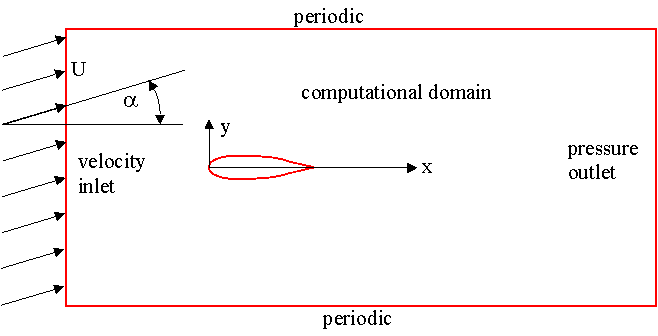
2. Flow over Airfoil problem is elaborated here - including meshing attributes and Fluent runs


http://www.me.psu.edu/cimbala/Learning/Fluent/fluent_airfoil.htm

Nice discussion thread on comparing the airfoil simulation data and simulation results
http://www.cfd-online.com/Forums/fluent/69598-comparison-airfoil-0012-experimental-result-simulation-result.html


3. For people who have tried to convert Ansys CFX to Fluent files this thread could be helpful:

http://www.cfd-online.com/Forums/fluent/43405-converting-ansys-cfx-files-fluent-files.html

4. For species simulations, how about an thread for modeling biomass combustion with species transport model

http://www.cfd-online.com/Forums/fluent/45261-modelling-biomass-combustion-via-species-transport.html


Ofcourse, many can find what they are looking for in various CFD threads. I rather, try accumulating all the important topics / discussions from all the sources I come across so that other CFD researchers can simply use that time for something better !

CFD Code comparisons

Evolution and development of opensource codes have certainly invited a much need comparison of their performances with the commercial ones. The comparisons are definitely based on the applicability, in-built tools and solution accuracy.

There has been a number of articles, discussion threads in cfd-online and elsewhere detailing these differences. I came across one such thread wherein CFD'ists evaluated the opensource codes with commercials guys like Fluent, CFX in terms of portability, industrial applicability, multi-physics capability and use in research activities...

http://www.cfd-online.com/Forums/main/14872-openfoam-vs-fluent-cfx.html

In particular, aspects of geometry environment, CAD import, Meshing, Pre/Post processing, physical model implementation to name a few were brought into the conversation which drew very wide interest among several visitors to the popular cfd site. Inclusion of "professional" items within opensource codes, indeed, dominated the discussion. Several authors unanimously pointed to the primary differences between the opensource and commercial codes as being

1. ease of use
2. pre / post processing input and output data resp.
3. portability
4. accuracy of simulations
5. simulation speed and scalability
6. additional priorities in handling industrial needs
7. availability and applicability of physical models

In my opinion, opensource codes such as OF provide, to a large extent, flexibility to the user (if the user is more towards model development and numerics) while still requiring some definite help from other opensource / commercial tools for pre/post processing (which is of more importance for an application engineers / decision makers...:) ). Certainly, in the recent times, open source codes have been well embraced by several research institutions and industries and they have started exploring the idea of fine tuning the code to suit their specific needs - a scenario not quite possible or may take long time to establish using commercial codes.

A note by Nelson of innovative-CFD on several other opensource development and application presents interesting overview of the CFD consulting world.

http://www.innovative-cfd.com/free-cfd.html


I came across some comparison tests between OF and other codes.

A nice presentation of the simulation of the implementation of Rotor-Stator interfaces in openFoam and comparisons with Numeca and CFX from the openFoam workshop held in 2008.

http://www.openfoamworkshop.org/08/presentations/Turbomachinery/BlaimBormFrobelKau1.pdf


An recent journal article on the comparison of openFoam with commercial code fluent in capturing bubble columns is a good starting point for multiphase researchers.

http://www.aidic.it/cet/09/18/098.pdf

an cfd-online thread on comparison tests including turbulent effects

http://www.cfd-online.com/Forums/openfoam-solving/59318-comparison-openfoam-fluent-experiment.html

Basic comparisons: flow past cylinder cases
http://www.cfd-online.com/Forums/openfoam-solving/58189-openfoam-vs-fluent-cylinder-re-3d150.html

STARCD vs OF : http://www.cfd-online.com/Forums/openfoam-solving/59753-starcd-vs-openfoam.html

The search for the "perfect" software which does not drill into our pockets is still on....